

Exam sources checked: . See source versions and claim types.
For CompTIA Security+ SY0-801, start with one main study guide or lesson sequence, then add practice that addresses your gaps. Choose version-matched materials whose sample explanations you can restate in your own words. Use practice questions, performance-based questions (PBQs) or labs to check what you can apply, and confirm access and update terms before purchasing.
This guide gives you a practical way to compare CompTIA Security+ V8 study materials. It is a selection framework, not a ranking of products we have not reviewed. The aim is to choose a manageable set of resources that addresses your learning needs.
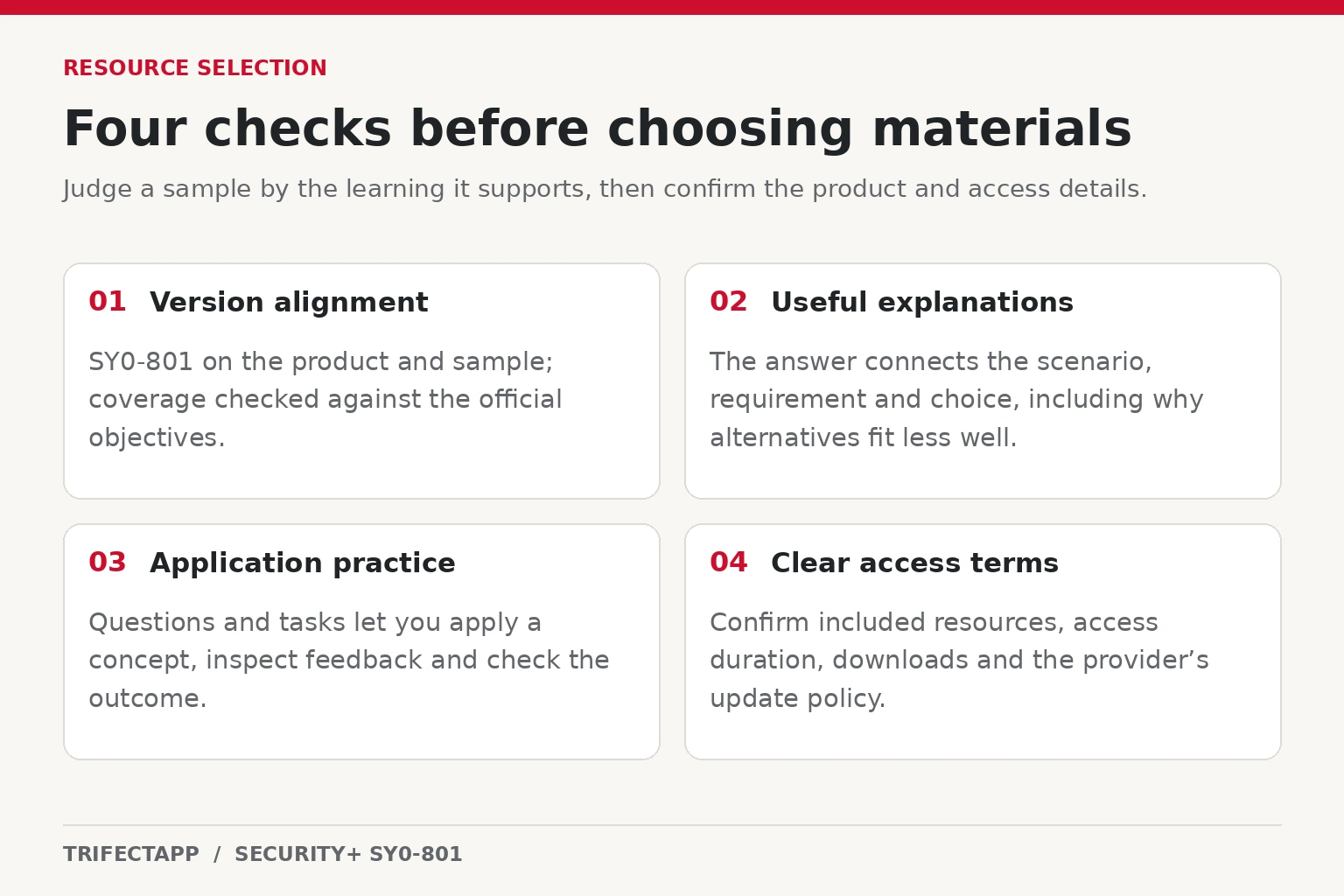
First, check SY0-801, V8 and the objectives revision
Look for SY0-801 on the product page, sample chapter and course outline. “Security+,” “updated” or a recent publication year alone does not tell you which exam blueprint a resource follows. If the edition is unclear, ask the publisher before purchasing.
CompTIA’s SY0-801 objectives PDF identifies the exam as V8 and the document revision as version 2.0. These numbers describe different things: V8 is the exam version; 2.0 is the objectives document revision checked for this article. A guide’s own edition number is a third identifier.
Compare its contents with the official PDF. For a focused spot check, find coverage of objective 2.6 on AI-related risks and objective 4.6 on operational automation. Then check a familiar subject too. A fashionable new chapter is not evidence that the rest of the coverage is accurate or complete.
Our SY0-801 exam-objectives guide helps you navigate the syllabus. Use the official document to confirm the full scope and check whether a newer revision is available.
Choose study materials by the job they need to do
A long resource list can create duplicate work. Begin with one main explanation source, then add practice that reveals something reading alone does not show. The table below describes useful roles, rather than claiming that every product in a format has those qualities.
| Resource | Useful role | What to inspect |
|---|---|---|
| Book or PDF study guide | Explain concepts and provide a reference you can revisit | Sample chapter, navigation, worked examples and objective mapping |
| Video lessons | Walk through a process or demonstrate a task | A complete sample lesson, captions and clear explanations of decisions |
| Practice questions | Expose gaps in knowledge and reasoning | Original scenarios, answer rationales and explanations of alternatives |
| PBQ practice | Apply concepts to a defined scenario task | Instructions, meaningful feedback and a visible way to reset |
| Local or simulated labs | Connect an action to an outcome you can verify | Setup requirements, evidence checks and cleanup or reset steps |
| Flashcards and quick references | Recall terms and distinctions between concepts | Accurate definitions, examples and links back to fuller explanations |
CompTIA’s objectives (version 2.0, page 3) list multiple-choice and performance-based questions in the official exam format. That makes application practice relevant, but a provider’s simulation should not be assumed to reproduce an actual exam task or interface.
Test a sample explanation before judging the whole guide
Choose a sample topic you partly understand. Read it, close it and explain the idea in your own words. Reopen the material and check whether it supplied the reasoning you needed. Attractive formatting and familiar terminology can make weak explanations feel more complete than they are.
Here is an original learning example for assessing explanation quality:
A reporting service needs to read files from one export folder. Its account currently has write access across an entire department’s shared storage. Which change most directly reduces unnecessary access while preserving the reporting task?
- A: Encrypt every file in the shared storage.
- B: Limit the account to read access on the required export folder.
- C: Increase retention of the account’s activity logs.
- D: Rotate the account’s password more frequently.
A thin explanation says, “B is correct because of least privilege.” That names the principle but leaves the learner to connect it to the scenario.
A useful explanation identifies the required operation, the required location and the excessive permission. B removes unnecessary write access and unrelated folder access while retaining the authorized task. Encryption addresses data protection, longer log retention supports investigation, and password rotation changes a credential; none directly removes the stated excess permissions.
The principle can be checked against NIST’s least-privilege definition; the reporting-service scenario and answer choices are Trifectapp’s own teaching example. The explanation should also preserve the scenario’s assumptions. In a real environment, you would check inherited access and verify that the reporting task still works. That additional observation teaches careful application without pretending the short question describes every operational detail.
Use this test on a provider’s sample: does the explanation connect evidence, requirement and choice? Does it explain why a tempting alternative fits less well? Could you apply the reasoning if the account needed to write a report instead?
Inspect the feedback in questions, PBQs and labs
Look beyond the number of activities. A useful practice question gives enough information to support its intended answer. If several choices could reasonably work, the scenario should provide the constraint that distinguishes them. Feedback should teach the distinction.
For a PBQ, try to identify the goal before touching the controls. After submitting, check whether the feedback explains a wrong decision or only displays a total. Our Security+ SY0-801 PBQ guide explains how to approach these practice tasks.
For a lab, inspect what you will actually do and how you will check the result. A local exercise may require installed software; a browser simulation may provide only selected controls. Either can support learning when its scope is clear. The eight Security+ V8 practical exercises show examples with tasks, expected evidence and reset steps.
A quick decision matrix for choosing your next resource
| Your current difficulty | Prioritize | Try before committing |
|---|---|---|
| You recognize terms but cannot explain them | A clear guide or lesson sequence | Explain a sample concept without looking at it |
| You understand a chapter but miss scenario questions | Questions with detailed rationales | Compare the explanation of the correct and most tempting wrong answers |
| You can select answers but struggle to perform a task | PBQs and practical exercises | Complete a task, verify the outcome and explain your choices |
| You forget subjects studied earlier | A review system using existing notes and questions | Revisit an older topic before buying another complete course |
| You have older-version materials | A coverage audit against SY0-801 | Find the missing or insufficiently explained objectives |
This is a learning decision, not a fixed product formula. Your next useful step may be a better explanation, practical feedback or a more consistent review habit.
Check access, updates and usability before purchasing
Read the actual access terms. Establish what is included, how long you can use it, whether downloads are available, and whether future exam editions are covered. “Lifetime access” should not be interpreted as a promise of every future product or version unless the terms explicitly say so.
Check the update process too. Look for a revision date, an errata page or a way to report a suspected error. For a PDF, test navigation and text readability on the device you intend to use. For video, inspect captions and controls. For labs, confirm software, operating-system and account requirements before assuming they will work with your setup.
Assess the total learning cost: money, setup effort and time spent repeating material. More pages, longer videos or larger question banks do not independently establish quality. A sample you can understand and use is stronger evidence than a quantity claim.
How to evaluate Trifectapp’s V8 materials
The Trifectapp Security+ SY0-801 training page lists an exam study guide, practice exams, PBQs and simulated labs, plus performance insights. Its published outline includes a study-guide section and an objective-by-objective reading map. It also provides public demonstration activities you can inspect before choosing your preparation route.
Apply the same criteria here: read a sample, explain the answer, try a practical task and decide whether the approach addresses your gap. Use the free SY0-801 practice questions for an initial check, then organize your chosen resources with the eight-week study-plan example.
Original practice resource
Try it: inspect a study resource before adding it to your plan
Inspect one resource you already own or can sample. Write down what you actually found, what remains unknown and the next question to ask. A product label or a large question count is not a completed inspection.
- Name the learning gap. Write one task you want help with, such as explaining an unfamiliar scenario or checking your work in a lab. Choose a sample relevant to that task.
- Check the edition and scope. Record the exact title, edition and stated exam code. Find the matching official objectives document, record its revision, then locate the specific objective and resource section you inspected.
- Test the explanation. Close the sample and explain the answer in your own words. Record the evidence that supports the choice and why one tempting alternative fits less well.
- Inspect a practical activity. Find its goal, setup, expected evidence and reset steps. Record which steps you can actually try with your device and access.
- Resolve access questions. Record the published access period, included formats, update terms and technical requirements. Leave unclear terms as questions for the provider.
- Choose one next action. Keep using the resource for a named gap, request a missing sample, or look for an alternative. Support your choice with observations, not a total score.
Two fictional inspection rows
These invented resources illustrate the method. They are not reviews, rankings or claims about any real provider.
| Fictional sample | Evidence observed | Reasonable next action |
|---|---|---|
| “Harbor Notes,” sample chapter | Names its intended exam code and explains a choice using the scenario constraint. The sample has no practical verification step. | Use the explanation for this topic; inspect a separate task before assuming it supplies application practice. |
| “Maple Practice,” sample activity | Includes a goal and reset button, but feedback only says “incorrect.” Its update terms are unclear. | Ask for a complete worked explanation and written update terms before deciding whether it fills your gap. |
A useful completed record separates “observed,” “not found” and “not yet checked.” Missing evidence is a question to resolve, not proof that the whole product is poor.
Download the study-resource inspection pack (ZIP)
Includes a printable worksheet, a blank CSV for your own records, the worked example and a short README. No account is required. Extract the ZIP, open the HTML file in a browser and print it or save it as a PDF. Use the CSV for editable notes.
Your Security+ study-materials checklist
- The resource clearly identifies SY0-801 and V8.
- The contents can be checked against the current official objectives.
- A sample explanation connects the requirement to a justified decision.
- Question feedback explains plausible alternatives, not only the answer letter.
- Practical activities state their setup, limits and verification steps.
- The format works on your device and fits your available study time.
- Access, update and purchase terms are clear.
- You can name the learning gap this resource will help address.
Security+ SY0-801 study-guide FAQs
Is a PDF study guide enough on its own?
That depends on its activities and your existing skills. Use it as an explanation source, then check whether you can answer unfamiliar scenarios and demonstrate practical reasoning. Reading completion alone does not establish readiness.
Can I reuse a SY0-701 study guide?
It may remain useful for shared concepts. Compare its coverage with SY0-801 and add material for gaps. See our SY0-701 versus SY0-801 comparison before treating an older guide as your complete syllabus.
Should I buy several guides to be safe?
Start with a clear purpose for each. A second explanation can help with a difficult topic, but several overlapping courses can divide your attention. Test what you already have before expanding the collection.
What makes a useful final choice?
Choose version-matched material whose samples you understand, whose practice reveals actionable gaps and whose terms fit your needs. Then use it consistently and reassess based on what you can explain and do.
Sources, versions and claim types
Exam-source check: November 7, 2026. This guide references CompTIA Security+ SY0-801 V8 objectives, document version 2.0: page 3 for exam format, objective 2.6 for AI-risk coverage and objective 4.6 for automation. These define what to check, not a ranking of training providers.
- Technical principle: NIST’s least-privilege glossary entry supports limiting permissions to the authorized task. The sample question is original Trifectapp material.
- Product evidence: the description of Trifectapp’s offer links to its Security+ training page; that description was checked on November 4, 2026. Check its current curriculum and published terms before purchasing.
- Editorial guidance: the selection criteria, inspection workbook, fictional resource rows and decision matrix are our suggested evaluation method, not independent product testing or CompTIA requirements.