

Learn CompTIA Security+ SY0-801 acronyms by connecting each term to a security decision. Knowing that RPO means recovery point objective helps; knowing it describes how much recent data loss the business can tolerate helps you choose a backup strategy.
This guide explains 41 selected acronyms from the acronym appendix in CompTIA’s SY0-801 V8 objectives, version 2.0. It is a focused learning reference with original examples, not a reproduction of the complete appendix. Use the official document for the full list and our V8 objectives guide to connect vocabulary to the wider syllabus.
Identity and trust: who gets access?
Start with the security goal, then identify the mechanism that supports it. Authentication, authorization and encryption solve different parts of the problem.
| Acronym and expansion | Meaning and example |
|---|---|
| AAA — Authentication, Authorization, and Accounting | Verify identity, decide permitted actions and record activity. An employee signs in, receives read access and leaves an audit trail. |
| CIA — Confidentiality, Integrity, and Availability | Keep information appropriately private, accurate and usable. Payroll needs all three: restricted access, correct amounts and timely processing. |
| MFA — Multifactor Authentication | Require distinct factor categories. A password plus a separate possession factor can qualify; two passwords do not. |
| OTP — One-time Password | A code intended for one authentication use. A changing authenticator code can demonstrate possession, but an OTP alone does not establish MFA. |
| SSO — Single Sign-on | Use one authentication session to access multiple services. Signing in once opens both a learning portal and a document application. |
| SAML — Security Assertion Markup Language | Exchange identity-related assertions between systems. An identity provider sends an assertion that a business application validates for federated sign-in. |
| OAuth — Open Authorization | Delegate limited access. A scheduling application receives permission to read a calendar without receiving the user’s password. |
| PKI — Public Key Infrastructure | The certificates, authorities, policies and supporting processes used to establish public-key trust. A company issues certificates to managed devices. |
| CSR — Certificate Signing Request | A request containing a public key and identifying information for certificate issuance. The corresponding private key stays with its owner. |
| CRL — Certificate Revocation List | A signed list identifying revoked certificates. A client can check whether an otherwise unexpired certificate has been revoked. |
| OCSP — Online Certificate Status Protocol | Obtain a certificate’s revocation status through a protocol response, rather than downloading an entire CRL. Status checking still needs correct validation. |
| TLS — Transport Layer Security | Protect a communication channel against eavesdropping and tampering. Proper certificate validation helps a browser authenticate the server it contacts. |
The distinctions follow NIST SP 800-63B-4 authentication guidance, the SAML 2.0 Core standard and the OAuth 2.0 framework (RFC 6749). OAuth alone is not a user-authentication protocol; SSO describes a sign-in experience rather than one particular protocol.
Threats and vulnerabilities: what are you investigating?
Reports often place several acronyms beside the same finding. Read them as different pieces of evidence.
| Acronym and expansion | Meaning and example |
|---|---|
| CVE — Common Vulnerabilities and Exposures | A system of identifiers and records for publicly disclosed vulnerabilities. Match an advisory’s CVE identifier to the affected product and version. |
| CWE — Common Weakness Enumeration | A classification of weakness types. Improper input handling can help explain the underlying defect behind a vulnerability. |
| CVSS — Common Vulnerability Scoring System | A framework for describing vulnerability characteristics and severity. Use its score and vector alongside exposure, exploitation evidence and business impact. |
| NVD — National Vulnerability Database | NIST’s vulnerability-data repository. Consult a record’s references, affected-product information and available analysis, while checking the vendor advisory. |
| APT — Advanced Persistent Threat | A capable, sustained adversarial threat. Long-term access and repeated attempts support this concept; one noisy alert does not establish attribution. |
| DDoS — Distributed Denial of Service | Disrupt availability using distributed sources. Many systems overwhelming an application can prevent legitimate users from completing transactions. |
| LLM — Large Language Model | A model trained to process and generate language. An assistant summarizing an untrusted document still needs boundaries around data access and actions. |
MITRE’s CWE description and FIRST’s CVSS v4.0 User Guide clarify the distinction between weakness classification and severity assessment. A CVSS base score alone is not an organization’s risk assessment. For the LLM example, continue with our V8 AI security guide.
Security operations: which capability does the work?
Products may combine several capabilities. Learn the role of each acronym before memorizing a product name.
| Acronym and expansion | Meaning and example |
|---|---|
| SIEM — Security Information and Event Management | Collect and analyze security events across sources. Correlating identity and application logs can reveal a suspicious sign-in followed by an export. |
| SOAR — Security Orchestration, Automation, and Response | Coordinate tools and repeatable response workflows. A playbook enriches an alert, opens a ticket and requests approval for containment. |
| SOC — Security Operations Center | The people and operational function monitoring and responding to threats. Analysts assess evidence and escalate incidents using defined procedures. |
| EDR — Endpoint Detection and Response | Investigate endpoint activity and support response. An analyst reviews a process chain and isolates a compromised laptop when authorized. |
| XDR — Extended Detection and Response | Connect detection and response across security domains. Email, identity and endpoint signals can be associated with the same attack. |
| IDS — Intrusion Detection System | Detect suspicious activity and alert. A network sensor reports a suspicious connection for investigation. |
| IPS — Intrusion Prevention System | Detect and attempt to stop intrusive activity. An inline control drops traffic matching a configured prevention rule. |
| DLP — Data Loss Prevention | Apply policies to sensitive-data handling. A rule can warn or block when a confidential file is sent to an unapproved destination. |
| CSPM — Cloud Security Posture Management | Assess cloud configurations and security posture. A finding flags storage exposed more broadly than organizational policy allows. |
Examples of these capabilities appear in Microsoft’s SOAR documentation, EDR overview and cloud security overview. An alert is evidence to assess, not automatic proof that an incident occurred.
Recovery and risk: which number answers the question?
| Acronym and expansion | Meaning and example |
|---|---|
| RTO — Recovery Time Objective | A target for restoring a disrupted service within an acceptable period. A two-hour RTO guides recovery planning and testing. |
| RPO — Recovery Point Objective | The required recovery point for data, commonly expressed as tolerable data-loss time. A 15-minute RPO calls for sufficiently recent recoverable data. |
| MTTR — Mean Time to Repair | The average repair duration across relevant events. Use consistent start and finish definitions when comparing repair performance. |
| MTBF — Mean Time Between Failures | Average operating time between failures of a repairable system. It describes reliability, not how quickly the next repair will finish. |
| SLE — Single Loss Expectancy | Estimated loss from one event. A hypothetical outage has an estimated business cost of $12,000. |
| ARO — Annualized Rate of Occurrence | Estimated annual event frequency. An estimate of once every four years corresponds to 0.25 events per year. |
| ALE — Annualized Loss Expectancy | Estimated annual loss: SLE × ARO. In this simplified example, $12,000 × 0.25 gives $3,000 per year. |
NIST’s RTO and RPO definitions separate recovery duration from the recovery point for data. Financial estimates also need documented assumptions; ALE is not a promise about what next year will cost.
Email and delivery: what does each mechanism establish?
| Acronym and expansion | Meaning and example |
|---|---|
| SPF — Sender Policy Framework | Authorize sending hosts for an email domain. A receiver checks whether the connecting host is permitted for the relevant envelope domain. |
| DKIM — DomainKeys Identified Mail | Associate a signing domain with a message through a verifiable signature. Changes to signed content can cause signature verification to fail. |
| DMARC — Domain-based Message Authentication, Reporting, and Conformance | Require SPF or DKIM authentication to pass with alignment to the visible From domain; publish handling policy and reporting preferences. |
| BIMI — Brand Indicators for Message Identification | Support brand-logo display for qualifying authenticated email in participating clients. A displayed logo does not establish that message content is harmless. |
| IaC — Infrastructure as Code | Define infrastructure through code or configuration files. A reviewed template consistently creates resources with approved security settings. |
| CI/CD — Continuous Integration and Continuous Deployment | Integrate changes and automate their path into deployment. Security checks in a pipeline can stop a change that violates policy. |
The email distinctions come from the SPF, DKIM and DMARC specification (RFC 9989, May 2026), plus the BIMI Group’s guidance. RFC 9989 replaces RFC 7489; a DMARC pass validates authorized use of the From domain, not whether the message is safe. For CI/CD, the V8 appendix uses “continuous deployment”; other contexts use CD for continuous delivery, which can retain a manual production-release decision.
Four distinctions worth practicing
- MFA versus SSO: MFA concerns authentication factors; SSO concerns reuse of a sign-in session. An organization can use both.
- CVE versus CWE versus CVSS: identify the vulnerability, classify the weakness, then describe severity. None alone establishes remediation priority.
- SIEM versus SOAR versus SOC: event analysis, coordinated workflows and the operational team are complementary concepts. One product may support the first two.
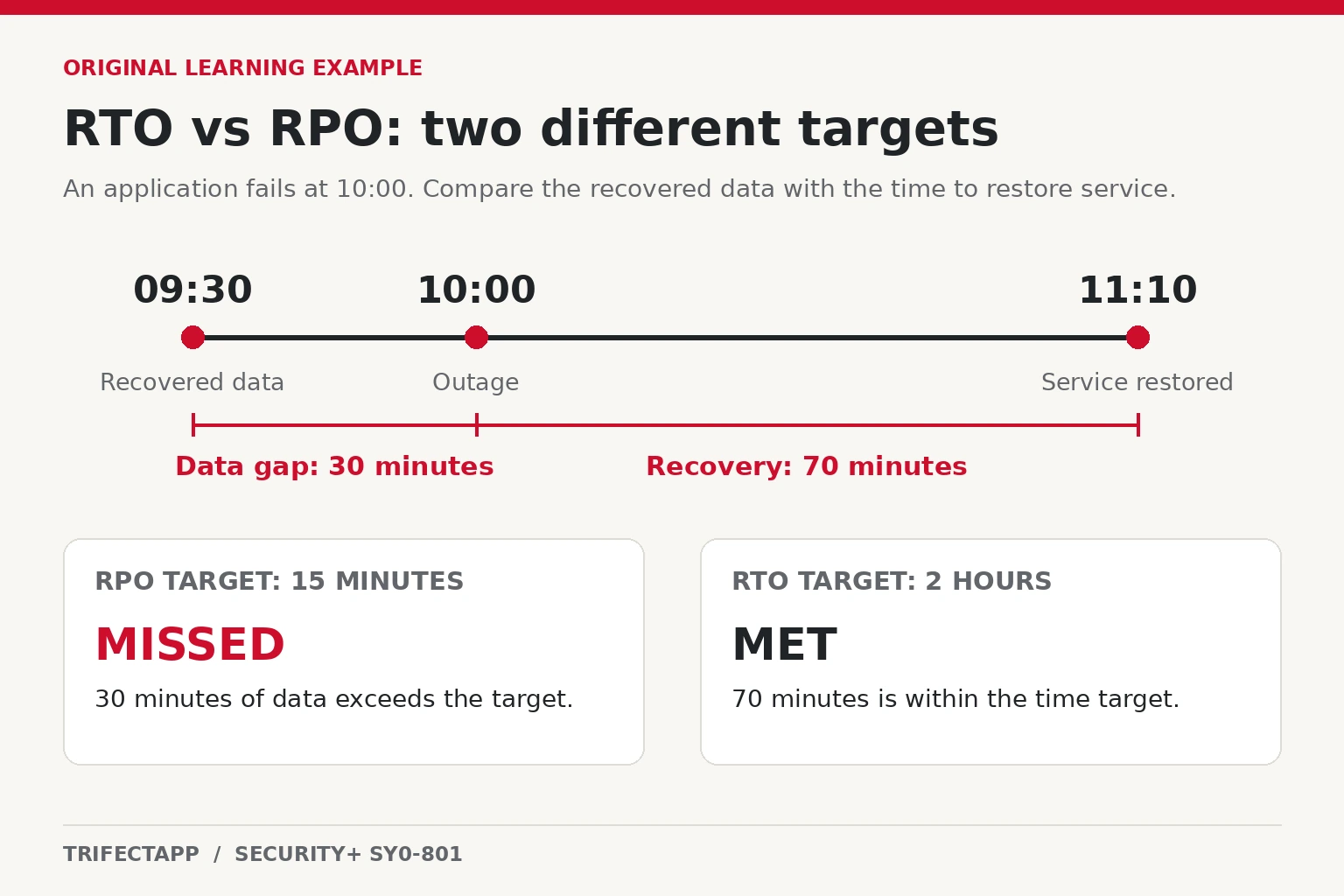
- RTO versus RPO: ask “How soon must service return?” and “How recent must recovered data be?” A successful restore can still miss either target.
Original Trifectapp practice · 8 original scenarios · About 15 minutes
Acronym scenario practice: choose the concept that fits
Use the evidence to distinguish nearby terms, then explain why the alternatives fit less well. These exercises draw on the 41-term guide reference; they are a selected vocabulary practice set.
Each case asks for the most specific concept supported by its facts. Products can combine capabilities; a label alone does not prove that a control is correctly configured. These are original fictional teaching scenarios, not official CompTIA exam questions.
Case 1 · One sign-in, two different factors
Evidence card
- A learner signs in with a password and a code from a separately held authenticator device. The code demonstrates possession of that device.
- After this sign-in, the learner opens the lab portal and document library without signing in again.
Worked solution and technical references
Best choice: MFA for the factors; SSO for session reuse. The password is a knowledge factor and the separately held authenticator supplies a possession factor. Reusing that sign-in across applications is SSO.
Verification or reasoning check: Name the knowledge and possession factors, then separately identify the reused sign-in session.
Why the other choices fit less well
- SSO for the factors; MFA for session reuse: This reverses the roles. SSO concerns reusing an authenticated session; MFA concerns distinct factor categories.
- OTP proves MFA, regardless of the password: OTP means one-time password. A single OTP can be one factor; the evidence of two distinct factor categories establishes MFA in this case.
- Two applications prove two-factor authentication: The number of applications does not establish the number of authentication factors.
Remember: Multiple steps do not automatically mean MFA; an SSO session can be established using MFA.
Technical context: NIST SP 800-63B-4: authentication factors · NIST: single sign-on. The scenario facts are original teaching inputs.
Case 2 · Calendar access without sharing a password
Evidence card
- A user approves a scheduling tool to read calendar entries through a scoped access token.
- The tool does not receive the calendar password. This question is about delegated API authorization, not proving the user’s identity.
Worked solution and technical references
Best choice: OAuth. OAuth enables limited delegated access using access tokens. The token’s scope and the resource server’s checks constrain what the tool may do.
Verification or reasoning check: Check the granted scope and the calendar resource server’s authorization decision; do not treat token possession as proof of a separate user-login protocol.
Why the other choices fit less well
- SAML: SAML exchanges security assertions and can support federated sign-in. The described scoped API access-token delegation is the OAuth use case.
- TLS: TLS protects a channel. It does not itself grant the scheduling tool the described calendar permission.
- PKI: PKI supports public-key trust and certificates. It is not the delegated API authorization framework described.
Remember: OAuth alone is an authorization framework, not a user-authentication protocol.
Technical context: RFC 6749: OAuth 2.0 authorization framework · OASIS SAML 2.0 Core. The scenario facts are original teaching inputs.
Case 3 · A root-cause classification
Evidence card
- An analyst has a vendor advisory for a particular vulnerability and a severity score.
- The analyst now wants a standardized classification for the underlying weakness type, such as an input-validation weakness.
Worked solution and technical references
Best choice: CWE. CWE classifies software and hardware weakness types. It answers the root-cause category question.
Verification or reasoning check: Separate the vulnerability identifier, its weakness classification, and its severity assessment before setting a remediation priority.
Why the other choices fit less well
- CVE: A CVE record identifies a specific publicly disclosed vulnerability; its identifier is not the weakness taxonomy.
- CVSS: CVSS describes vulnerability characteristics and severity. A score or vector does not replace a weakness classification.
- NVD: NVD is a vulnerability-data repository that can include links and analysis. The requested weakness taxonomy is CWE.
Remember: CVE, CWE and CVSS answer different questions. Severity alone is not business risk.
Technical context: MITRE: About CWE · FIRST: CVSS v4.0 user guide · NIST: NVD overview. The scenario facts are original teaching inputs.
Case 4 · An alert becomes a repeatable workflow
Evidence card
- Identity and application events are already collected and correlated.
- The team needs a repeatable workflow that enriches each qualifying alert, creates a ticket, and requests analyst approval before isolation.
Worked solution and technical references
Best choice: SOAR. SOAR coordinates tools and repeatable response steps. The approval gate remains part of the stated workflow.
Verification or reasoning check: Trace enrichment, ticket creation and the approval gate in the playbook; confirm isolation cannot run before the required approval.
Why the other choices fit less well
- SIEM: SIEM supports event collection and analysis, already present in this case. A product may combine SIEM and SOAR; the missing function is orchestration.
- SOC: The SOC is the operational team or function. Its people define and supervise the workflow, but the requested automation capability is SOAR.
- EDR: EDR investigates and responds on endpoints. It may execute an authorized isolation action, but it is not the whole cross-tool workflow described.
Remember: Name the capability, not only a product. One platform can include several security functions.
Technical context: Microsoft: Sentinel SOAR automation · Microsoft: endpoint detection and response. The scenario facts are original teaching inputs.
Case 5 · Service returns, but how much data is missing?
Evidence card
- An application stops at 14:00. The tested recovery restores service at 14:45 with data current through 13:50.
- The agreed RTO is 60 minutes; the RPO permits a data-loss window of no more than 5 minutes. Use these scenario definitions.
Worked solution and technical references
Best choice: RTO was met; RPO was missed. The 45-minute recovery is within the 60-minute RTO. Data is 10 minutes behind the outage, exceeding the stated 5-minute RPO.
Verification or reasoning check: Calculate 14:45 minus 14:00 for recovery duration and 14:00 minus 13:50 for the data gap; compare each with its own target.
Why the other choices fit less well
- Both objectives were met: Recovery took 45 minutes, but the 10-minute data gap exceeds the 5-minute RPO allowance.
- RPO was met; RTO was missed: This swaps the measures. RTO is checked against 45 minutes of downtime; RPO against the 10-minute data gap.
- Both objectives were missed: The RPO was missed, but the service returned within the allowed recovery time.
Remember: A working restored service does not by itself demonstrate that the recovery-point requirement was met.
Technical context: NIST: recovery time objective · NIST: recovery point objective. The scenario facts are original teaching inputs.
Case 6 · A status response for one certificate
Evidence card
- A client needs a signed response about an individual certificate’s revocation status.
- It is not requesting a new certificate and does not want to download a complete revocation list.
Worked solution and technical references
Best choice: OCSP. OCSP supplies certificate-status responses without requiring the client to obtain a full CRL. The response still needs proper validation.
Verification or reasoning check: Validate the responder’s authority, signature, certificate identifier and response freshness under the client’s policy. A status of good is not a substitute for all certificate checks.
Why the other choices fit less well
- CSR: A certificate signing request asks for certificate issuance. It is not a revocation-status response.
- CRL: A certificate revocation list lists revoked certificates. The case specifically requests an individual protocol response instead of downloading the list.
- PKI: PKI is the broader infrastructure supporting public-key trust. The specific status-query protocol is OCSP.
Remember: Issuing a certificate, maintaining trust infrastructure and checking revocation status are different jobs.
Technical context: RFC 6960: Online Certificate Status Protocol · RFC 2986: certification request syntax. The scenario facts are original teaching inputs.
Case 7 · Authentication must match the visible From domain
Evidence card
- A receiving mail system has checked SPF and DKIM.
- The next decision requires an authenticated SPF or DKIM identity to align with the message’s visible From domain, while considering that domain’s published handling preference.
Worked solution and technical references
Best choice: DMARC. DMARC evaluates alignment with the author’s From domain using authenticated SPF or DKIM results and communicates domain policy preferences.
Verification or reasoning check: Identify the visible From domain and the authenticated SPF or DKIM identity; check their alignment rather than accepting any unrelated pass.
Why the other choices fit less well
- SPF alone: SPF checks whether a host is authorized for the relevant envelope identity. An SPF pass alone does not establish alignment with the visible From domain.
- DKIM alone: DKIM verifies a signing-domain signature. A valid signature from an unrelated domain alone does not establish the requested alignment.
- BIMI: BIMI supports qualifying brand-logo display. The authentication-alignment mechanism requested here is DMARC.
Remember: Passing email authentication does not prove the message content is safe or the sender is trustworthy.
Technical context: RFC 9989: DMARC · RFC 7208: SPF · RFC 6376: DKIM. The scenario facts are original teaching inputs.
Case 8 · Alerting is not the requested stopping action
Evidence card
- A network control sits inline and is configured to identify and drop traffic that matches a defined attack signature.
- The requirement is automatic prevention at this point, not just an alert or a cloud-configuration review.
Worked solution and technical references
Best choice: IPS. An intrusion prevention system can detect and attempt to stop matching activity, including dropping traffic when configured to do so.
Verification or reasoning check: Use an authorized test to confirm the configured matching traffic is blocked and recorded, while expected legitimate traffic still passes.
Why the other choices fit less well
- IDS: An IDS detects and alerts. The explicit inline dropping requirement makes IPS the better match.
- CSPM: CSPM assesses cloud configurations and posture; it is not the inline signature-based traffic prevention described.
- DLP: DLP governs sensitive-data handling. The case describes an intrusion signature and inline prevention rather than a sensitive-data policy.
Remember: Prevention capability is not a guarantee that every attack will be detected or stopped.
Technical context: NIST SP 800-94: intrusion detection and prevention systems. The scenario facts are original teaching inputs.
Keep practicing offline
Download the acronym scenario and flashcard pack (ZIP)
Includes this offline activity, eight evidence cards, a blank reasoning worksheet, worked solutions and the guide’s 41-term CSV flashcard deck.
Activity v1.0 · November 7, 2026. Original teaching scenarios, not official CompTIA questions. Choices stay in the open page and clear on reload. This activity sends no answers and uses no persistent storage.
Three original quick checks
1. Does this login use MFA?
A user enters a password followed by a second memorized secret. Is that MFA?
Answer: No. Both are knowledge factors. Multiple steps do not necessarily provide multiple factor categories.
2. Did recovery meet both objectives?
An application fails at 10:00. Service returns at 11:10 with data from 09:30. Its RTO is two hours and RPO is 15 minutes.
Answer: The 70-minute recovery meets RTO. The 30-minute data gap misses RPO. Measure both outcomes during a recovery test.
3. Which capability fits the task?
A team needs to combine identity and application logs, then automatically enrich qualifying alerts and create tickets. Which two capabilities fit?
Answer: SIEM supports collecting and correlating the events; SOAR supports the repeatable workflow. The SOC defines procedures and investigates the resulting evidence.
Security+ SY0-801 acronym FAQ
Is this every acronym in the V8 objectives?
No. These 41 terms are a selected reference. Review the complete appendix in the official objectives and include unfamiliar terms in your revision.
Should I memorize expansions or practice scenarios?
Do both. For each term, write its expansion, its purpose and one situation where you would use it. Then explain how it differs from a nearby concept.
Are these official exam questions?
No. The quick checks are original learning exercises. They do not predict particular questions or guarantee an exam result.
After reviewing the tables, try the free SY0-801 practice test. Use mistakes to identify concepts to revisit in our Security+ training course and apply them in the V8 practical exercises.
Sources and versions
Sources checked: .
- Official exam scope: CompTIA Security+ SY0-801 (V8), Exam Objectives Document Version 2.0, acronym appendix, PDF pages 24–26. These 41 terms are Trifectapp’s selection, not the complete appendix. The SAML expansion follows the OASIS standard.
- Technical editions: NIST SP 800-63B-4 (July 2025), OASIS SAML 2.0 Core (March 2005), OAuth 2.0 in RFC 6749, FIRST CVSS v4.0, and DMARC in RFC 9989 (May 2026). Their links appear beside the explanations they support.
- Trifectapp study advice: The comparisons, fictional examples, scenario choices and suggested practice are teaching aids. They do not define extra exam requirements or predict an exam result.
Certificate references: RFC 5280: certificate and CRL profiles, RFC 6960: OCSP and RFC 8446: TLS 1.3. Vulnerability data context: NIST’s NVD overview. Product documentation describes implementations, not additional CompTIA requirements.